01
Capture the change
Collect the developer request, agent summary, Git diff and relevant project context.
CHANGE CONTEXTAI coding agents ship changes faster than anyone can review them. Regression Guard verifies what a change should do — and what must keep working. Automatically, with evidence you can hand to a reviewer.
Built on your existing project and Playwright checksDesigned to run locally, no source upload
Expected inventory: 12
Observed inventory: 11
The coupon claim flow appears to trigger an unexpected inventory decrement.
Follow one code change through the workflow: identify intended behavior, reuse approved checks, and report what the evidence actually proves.
Regression Guard reads the change context and separates the new behavior that should work from existing behavior that must remain unaffected.
Change context, behavioral expectations, reusable checks and deterministic execution are one loop — not four disconnected features.
Collect the developer request, agent summary, Git diff and relevant project context.
CHANGE CONTEXTIdentify target behavior and the existing behavior that must remain intact.
EXPECTATIONSReuse approved checks first. Propose new ones only where coverage is missing.
CHECK ASSETSExecute against the intended code version and capture the relevant observations.
PLAYWRIGHT + EVIDENCEReturn PASS, FAIL or UNKNOWN with evidence a developer or agent can act on.
TRUSTED FEEDBACK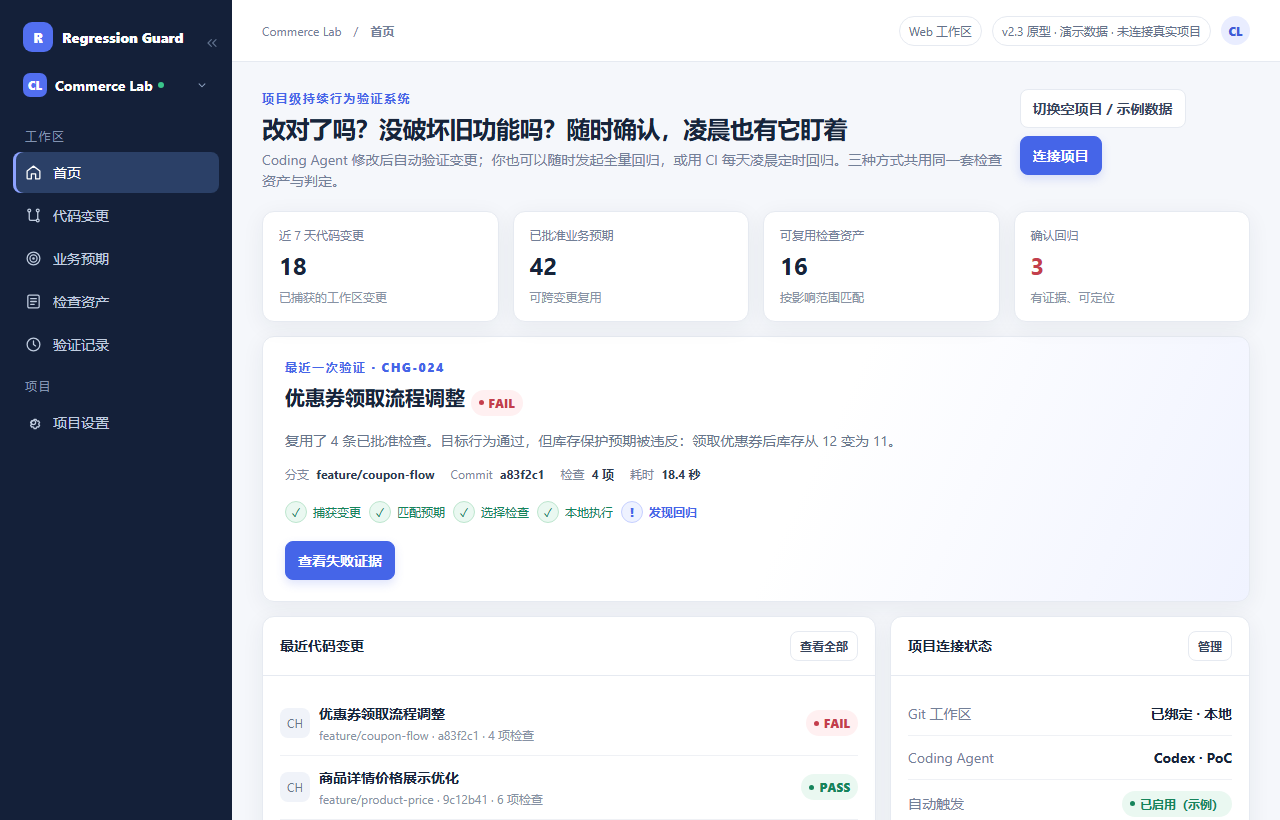
The actual workspace prototype — light UI, sample data. The dark panel above is a concept mock-up, labeled as such.
A regression check should become a reusable project asset, not disposable code written for a single run.
Approved expectations and their checks carry forward to future changes. As coverage grows, repeated manual analysis shrinks — without silently changing what the team considers correct.
Explore early access* illustrative asset states, not live product data
A browser run finishing successfully is not proof that a change is correct. A verdict has to rest on approved expectations and sufficient evidence.
Every required expectation has sufficient evidence that the observed behavior matches what was approved.
Evidence shows at least one required expectation was violated by the observed behavior.
Evidence is missing, execution is incomplete, or the result cannot be attributed to the change.
A verification tool must not introduce new risk while reducing regression risk. These are the design principles behind the product.
AI can propose expectations. A new business rule never becomes an approved fact on its own.
Every result names the code, check, expectation and environment versions it belongs to.
Test actions use explicit permissions and controlled data. Dangerous operations do not run by default.
Incomplete evidence, unstable environments and ambiguous outcomes are reported as UNKNOWN, not hidden.
These statements describe intended product principles. Deployment, data handling, permissions and integration guarantees must be verified against the actual implementation before being presented as operational security claims.
Draft tiers for a pre-release product. No plan is purchasable today, and every entitlement below is proposed scope rather than a shipped feature. Prices may change before launch.
Proposed scope: get one project verified end to end.
Proposed scope: one person or a small team.
Proposed scope: approval and audit for teams.
The current engine makes zero model calls during a normal regression run. Verdicts are computed from deterministic assertions against human-approved expectations — verdicts never pass through a model, and swapping models cannot change a historical result. There is no API key to configure in the current build.
Model-assisted drafting and failure explanations are planned, not shipped. If they land, they will be bring-your-own-key: usage is billed directly by your provider and depends on the selected model, token usage and verification workload. We do not resell model calls or bundle credits, and we will not quote a per-run cost until we have measured one.
Prices and entitlements are indicative drafts for a pre-release product. No plan is purchasable today, and this page never charges anything.
AI coding is changing how fast teams ship. Here is how this product approaches the verification problem.
Not exactly. Generating a test is one part of verification. The product is built around understanding the change, separating target from protection expectations, reusing approved checks, executing them and producing an evidence-backed verdict.
No. Existing project checks are reused wherever possible, and missing ones are proposed. New business expectations still require review and approval — the goal is to remove repetitive work, not to hide decisions.
No. Playwright is the browser execution engine. This sits above it: change understanding, expectation governance, check reuse, evidence collection and verdict handling.
Then the verdict is UNKNOWN, not PASS. Incomplete execution, insufficient evidence and environment problems stay visible so someone can investigate them.
Integration is an engineering problem, not a diagram claim. Supported agents are listed only after the end-to-end flow has actually been verified. The first release supports one project and one agent.
No testing system can honestly promise that. The point is to lower verification cost and raise confidence by checking approved behaviors with traceable evidence. Coverage limits stay explicit.
Build a verification loop around the project you already have, the behaviors you already approved, and the checks you already trust.
No credit card · onboarding in small batches · you can leave at any time